
Lightweight Design for Technical Interior Equipment
Smart Use of Specialty Metals with Mokawa
1. Why Lightweight Design Matters
In many companies, technical interiors still look like this:
- heavy steel frames in laboratories and technical rooms
- massive machine enclosures
- test rigs and functional furniture that are difficult to move
- corroded components in humid or chemically stressed environments
The consequences:
- assembly and modifications require significant time, manpower, and lifting equipment
- ergonomic strain on employees
- downtime due to replacement or repairs
- limited design flexibility and weight reserves
Lightweight design for technical interiors does not mean “designer furniture”. It means functional, high-quality technical interior solutions that weigh less, last longer, and are better adapted to real operating conditions.
Mokawa is not a furniture manufacturer, but a material and manufacturing partner for specialty metals, refractory metals, and alloys that make interior structures in laboratories, cleanrooms, plant interiors, and R&D environments lightweight, robust, and durable.
2. Material Basis: Which Metals Mokawa Supplies – and What They Are Used For
2.1 What Are Specialty Metals and Refractory Metals?
- Specialty metals: metals with specific properties such as high corrosion resistance, temperature stability, biocompatibility, or vacuum compatibility.
- Refractory metals: very high-melting-point metals such as molybdenum, tungsten, tantalum, and niobium.
- Alloys: metal combinations such as Invar, Kovar, or Inconel for specific technical requirements.
2.2 Mokawa – Core Materials at a Glance
| Material | Typical Strength | Lightweight Role | Typical Supply Forms |
| Titanium (Ti) | Lightweight, strong | Lightweight, corrosion-resistant structural & connecting components | Bars, tubes, sheets, wires |
| Molybdenum | High-temperature resistant | Components in hot zones, radiation, process heat | Sheets, bars, wires, custom parts |
| Tungsten | Extremely temperature-resistant | Radiation shielding, heat shields | Bars, sheets, wires, tubes |
| Tantalum | Extremely corrosion-resistant | Liners, claddings, acid-resistant internal components | Sheets, tubes, wires, custom parts |
| Niobium | Temperature- & corrosion-resistant | Special applications, alloying element | Semi-finished products, custom parts |
| Zirconium | Chemically resistant | Interior construction in the chemical & process industries | Blanks, sheets, tubes |
| Nickel alloys | Strong at high temperatures | Slim, load-bearing components in high-temperature areas | Semi-finished products, custom parts |
2.3 Glossary – Short & Clear
- Tolerances: permissible dimensional deviations of a component.
- Refractory metals: high-melting-point metals such as Mo, W, Ta, Nb.
- Alloys: metal mixtures designed for defined properties.
3. Lightweight Design in Practice: Where Technical Interiors Really Benefit
3.1 Laboratories & Research
Requirements:
- chemical resistance
- modularity
- easy cleaning
- low weight
Examples:
- titanium supports for laboratory shelving and equipment mounts
- zirconium or tantalum inserts in highly aggressive media zones
Reflection question: Which of your laboratory furniture or test setups are currently too heavy or prone to corrosion?
3.2 Cleanrooms & Medical Technology
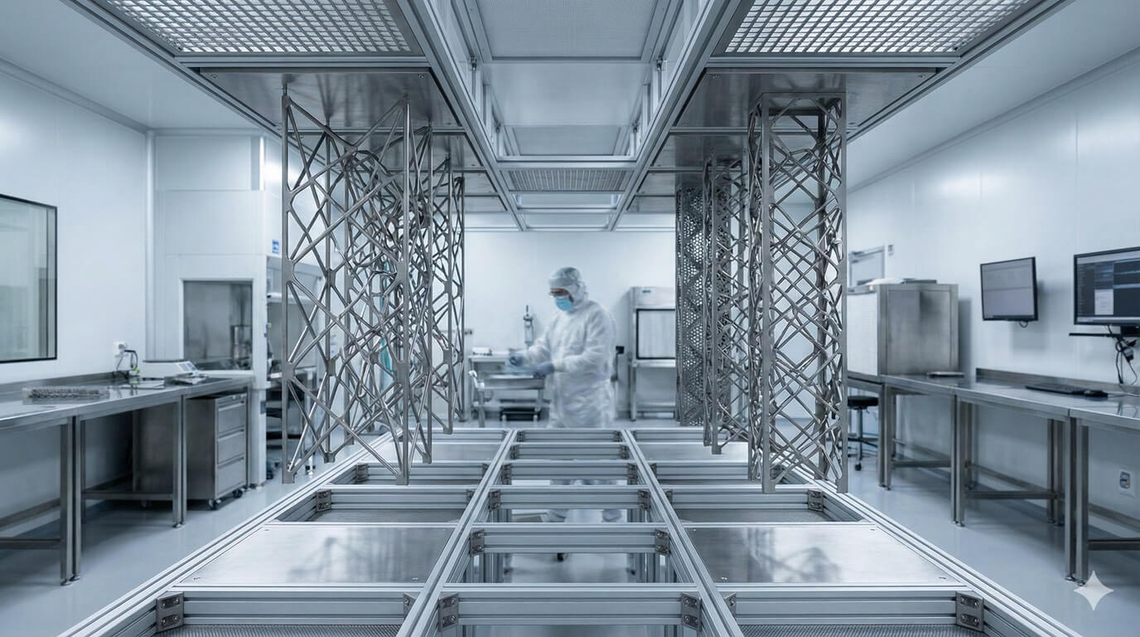
- titanium frames for cleanroom modules
- nickel alloys for hot or aggressive sterilization environments
3.3 Plant Interiors & Test Rigs
- molybdenum and tungsten for radiation and heat shielding
- tantalum / zirconium as thin-walled liners
3.4 Technical Furniture & Functional Modules
- titanium screws and nuts instead of standard steel
- lightweight support frames made of titanium or nickel alloys
Question: Does this module need to be moved regularly? Can employees handle it safely?
4. Technical & Economic Benefits – At a Glance
4.1 Technical Advantages
- weight reduction in load-bearing and moving parts
- high temperature resistance
- excellent corrosion resistance
- thin-walled, space-saving designs
4.2 Economic Advantages
| Lever | Short-term Effect | Long-term Effect |
| Lower weight | easier assembly | less damage & wear |
| Corrosion resistance | fewer replacements | longer service life |
| Temperature resistance | stable operation | planning reliability |
| Modularity | faster conversions | better utilization of the investment |
5. How a Lightweight Design Project with Mokawa Works
5.1 Typical Steps
- Inquiry & scope clarification: operating conditions, drawings, quantities.
- Material shortlist: selection of suitable metals.
- Design & DFM: recommendations for wall thicknesses, tolerances, threads.
- Manufacturing: CNC milling, turning, drilling, polishing.
- Delivery & follow-up projects: from prototype to series production.
5.2 Checklist for Your Inquiry
- Application area: laboratory, cleanroom, test rig?
- Temperature range: continuous load & peaks?
- Media: acids? moisture? gases?
- Mechanical requirements: loads, cycles, vibrations?
- Tolerances: which areas require high precision?
- Batch size & timeline?
6. Why Mokawa Is a Strong Partner
| Advantage | Benefit for You |
| Focus on special metals | Access to high-performance materials |
| In-house production of custom parts | If required: material + machining from a single source |
| ISO 9001 certification | Reliable quality assurance |
| Experience since 1977 | Industrial and research expertise |
| Customer base: industry & research | Proven solutions for demanding environments |
7. Conclusion
Lightweight design for technical interior equipment means lower weight, better handling, higher durability, and reduced life-cycle costs.
With specialty metals such as titanium, molybdenum, tantalum, tungsten, niobium, zirconium, and nickel alloys, interior structures can be designed to match your specific operating conditions.
Your Next Step:
- Do you have a component that is too heavy or prone to corrosion?
- Would you like to evaluate the economic feasibility of a material change?
- Do you need drawing parts or prototypes made from specialty metals?
Contact Mokawa for a non-binding consultation.